Monday, January 13, 2014

The Memory in Smelling

Here’s one question that may interest you: Have you ever smelled something that reminded you of an object from your childhood that you had completely forgotten about for a long time? When I first read this online, I was immediately intrigued by the possibility that a connection between our sense of smell and memories does exist. As bizarre as this might sound, I was recently at a mattress store, and the smell of one of the displayed blankets suddenly reminded me of a pillow that I was obsessed with in elementary school. The concept of the sense of smell somehow awakening long-gone memories piqued my interest; I decided to do some research about it, and I discovered that there actually is an incredible area in neuroscience dedicated to understanding the science behind such a connection.

One of the first articles that I found related to this was from BBC, and it stated that humans have a particularly hard time clearly communicating the smells that we can differentiate. In the case of the other four senses, it’s easy to describe how something, for example, sounds or looks like, but our smells aren’t so easy to delineate. As a result, we end up labeling our smells according to what we associate them with, often offering vague comparisons such as “It smells like potatoes.” From a non-scientific perspective, I tried to understand why this was. Does the English language have fewer adjectives dedicated to smelling than to seeing or hearing? Do people who speak different languages have a much easier time explaining what they smell to others? In addition, I wondered whether it’s possible that what we smell calls back long-forgotten memories because we often describe them with metaphors and similes and other associations that are dependent on our personal experiences. Could such an association act as an intermediary between a smell that I’m describing and a completely unrelated memory?

Despite the confusion and complexity that usually define neuroscience, there does seem to be an explanation for why the sense of smell is so different from other senses and why a connection between our memories and smells possibly exists. According to this piece published by Macalester University, all of our senses other than that of smell start at the sense organs and move to a neural organ called a thalamus before moving on throughout the rest of the brain. However, instead of going to the thalamus, our smell information travels directly to the olfactory bulb. Furthermore, another scientific fact that may explain the oddity is that the odors that we smell are molecular while the sounds and light that we hear and see, respectively, are waves. The most compelling information that provides evidence of a connection between memories and smell is that the olfactory bulb forms a direct link with the amygdala and hippocampus, which are colloquially known as the organs that form and store our memories.

Sure, these scientific discoveries do explain why our smells and memories sometimes get entangled, but they raise a whole new array of questions, including, “How come the connection occurs sporadically, meaning that I get reminded of a memory from a smell very rarely?” Personally, I'm not satisfied with the easy answer that I received from researching about this seemingly complex smell-memory relationship, despite its incredible implications for developing smell-based treatments for patients suffering from depression and dementia, according to this article from the New York Times. But since neuroscience and topics related to memory are still so nebulous and hard to explain on a fundamental level, I might need to wait much longer for a clear answer that's not just scientific. As for now, I guess I'll make a note to myself that whenever I feel a bit nostalgic, I just have to sniff a little harder.  

To learn more about the neuroscience behind the smell-memory relationship, you can read this piece.

Reflections on Blogging

Because I haven’t been a particularly active blogger this past semester, I believe that I still have not completely developed a unique personality for myself on my blog, “What’s Memory?” While the website’s character draws from my lens, memory, I feel that my writing doesn’t yet have a voice that any reader would immediately attribute to me. When I first started blogging for my sophomore English class, my writing was very quasi-academic because the rules for posting and interacting with the audience were very lax. As a result, I was surprised to learn this semester that becoming a proficient blogger actually had many prerequisites not limited to having thought clarity and very good writing skills, such as doing outside research. For example, while my blog does have posts that are cohesive in themselves, “What’s Memory” seems disjointed overall, despite my supposedly connecting theme of “memory.” One post would discuss the concept of memory in photojournalism while the next would illustrate how my past perceptions of Africa were debunked in class.
Besides those personal concerns, I’ve had an incredible experience writing my blog so far because it has made my learning especially in the Academy much more dynamic. While a majority of my posts were based off of ideas in English that piqued my interest, I also had to analyze such concepts via a lens of memory, which always made blogging challenging but rewarding. As a result of my efforts, I came up with and elaborated on some of my best ideas in several posts, most notably “Dealing with Brainwashing.”
In this post, I analyzed the eerie similarity between the Tiananmen Square and the Rabaa al-Adawiya Massacres as well as each respective government’s response to each event. At first, the only main connection I could find was that both the Chinese and Egyptian governments were using brainwashing and censorship tactics to blind their populations from learning about the massacres. However, I started to think in terms of solutions and wondered whether the social-media methods that Chinese activists are using to educate the Chinese population about Tiananmen Square can also be used in Egypt in order to make sure that the memory of Rabaa al-Adawiya does not disappear. Furthermore, I realized that since issues of brainwashing and censorship are so prevalent today, especially in Iran and North Korea, I wrote “how the Egyptians will work to successfully preserve the memory of Rabaa al-Adawiya may provide some clues about how people should combat, in this day and age, imposed efforts to intentionally revise history.”
After I looked back at my posts, I realized that most of the ideas that I developed in them were not actually pre-planned. I noticed that a majority of them arose only after I wrote a particular paragraph or sentence. Although I wish that my ideas and concepts weren’t spontaneous, I realized that especially in blogging, I’ve found it challenging to develop a comprehensive outline describing how I would structure and write a post. Perhaps this can be attributed to my misconception that the posts on professional blogs are all just rough drafts. Indeed, for the first couple of posts, I wrote directly in the word spaces rather than completing rough drafts as well as multiple revisions in separate word documents. Now, I do write and rewrite my posts in word documents, but I still come up with my best ideas spontaneously. Maybe this is just the way my brain naturally works in writing, but I hope to work on controlling my ideas before I start blogging.
            While I should reflect only on what I’ve learned from blogging, I think this piece would be incomplete without acknowledging my experience reading and commenting on other people’s blogs. On numerous occasions, I looked at my classmates’ blogs for some inspiration in composing my own posts. The insights that many elaborated from combining their unique lenses and topics discussed in Academy classes were often so incredible that I had to comment. For example, Matthew Bondy wrote an interesting post on how aid-giving can be paradoxically self-serving rather than entirely altruistic. This resulted in a comment session about providing aid vertically or horizontally and whether intentions behind providing aid really matter.
            Despite my hardships adapting to the numerous rules of blogging this semester, my experiences writing online have been very rewarding, challenging me to juxtapose ideas discussed in class and concepts in memory. With the intellectual exercises that came with writing online, blogging has definitely been a very integral part of English. 

Word count: 749

Monday, December 9, 2013

Thoughts on Reading Lolita in Tehran

Currently in English, we're reading a memoir entitled Reading Lolita in Tehran written by an Iranian writer and former professor named Azar Nafisi. While the memoir does discuss Nafisi's experiences before and during the disillusioning cultural and social changes that the 1979 Revolution wrought in Iran, the text focuses primarily on the development of an intimate literature group of seven intelligent female students that Nafisi secretly formed after her voluntary expulsion from the University of Tehran for refusing to wear the veil. In discussing many books, such as Lolita by Vladimir Nabokov and The Great Gatsby by F. Scott Fitzgerald, the members of the group had the intention of creating fictional havens in which they could escape the reality of Iranian society's oppression on women. Indeed, many of the books included characters and plots that focused around themes akin to oppression, the risks of attempting to actualize dreams, and the duality between privacy and public arena, which are all topics that resonate with Nafisi and her students. Although Nafisi did not want her students' outside lives to intrude on the group's book discussions, it was sometimes impossible to ignore the problems that they constantly faced. 

Besides the discussion group's conversations, one major theme presented in Reading Lolita in Tehran is Nafisi's attempt to patch up the sudden schism between a culturally rich Iran in which women had as many rights as the women in western nations and a theocratic Iran whose mission seems to be to destroy any vestige of the former Iranian society. Nafisi's sentiments about her disillusionment can be found in the beginning parts of the Gatsby section: when Nafisi returned from her schooling in England with feelings of hope and nostalgia, the revolution had already taken place, and she found portraits of Ayatollah Khomeini and enormous posters reading "AMERICA IS OUR NUMBER-ONE ENEMY!" What's even more tragic is that while in England, Nafisi tried to transform her landscapes and learning environments into something that was similar to her understanding of "Iran." Most of her memories about her stay in Europe were directly related to what reminded her of "home." And yet, her concept of "home" or "Iran" vanished with the passing of the revolution. Because her memories of Europe were based off her past "Iran," were they essentially meaningless?

In the end, Azar Nafisi and several of her students left Iran for the United States, Europe, and other places, perhaps out of their frustration with how Iranian society has been based mostly on fundamentalist ideology and uncompromising condemnation of westernization rather than on the actual development of Islamic ideals that stray from the "corruption" that many revolutionaries believed were tied into the pre-revolution Iranian regime. Indeed, as this article from PBS states, the only freedom that the pre-revolution regime prevented the Iranians from having was political freedom, and the original revolution was centered around attaining that. However, in the process, most of the people's freedoms were stripped from them. With the scary internet and literary censorship that the Iranian government currently implements on society, it's hard to determine the true opinions of people about the changes that the shift in regimes has brought about. It'd be interesting to note what memories the Iranians still have about the past and if such recollections are better, in any way, than what they are currently experiencing. 


Monday, November 25, 2013

Dealing with Brainwashing

For the past couple of posts, I've written exclusively about the various implications of possessing very malleable memories as individuals. As a result, I've decided to take a detour and explore a prevalent issue in collective or societal memory instead: intentionally revising history.

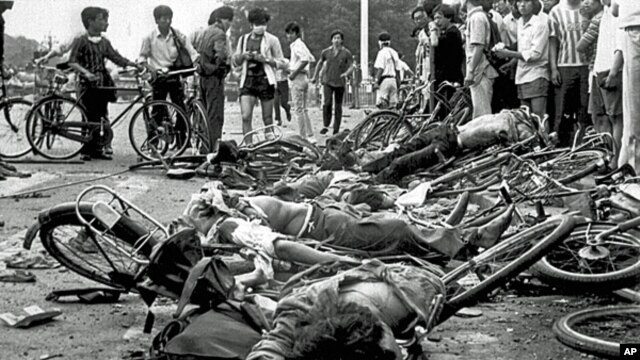
For me, one case in history that best exemplifies that practice is the iconic censorship policies China had implemented to combat its tainted image after the Tiananmen Square Massacre in 1989. According to this contemporary article in the New York Times, as many as two thousand pro-democracy protestors were slaughtered by the military acting under government command, which perceived the demonstrations as a "counter-revolutionary riot." To be completely honest, only until recently, I never really took the surprising efficacy of today's Chinese censorship very seriously. This recent article from the Guardian stated that Chinese officials' efforts to "maintain their legitimacy" are so painstaking that even words and numbers only vaguely connected to the massacre, such as "special day" and "64," are censored. And, a simple search on Google Images would show pictures of Tank Man and bloodied corpses while the same search on any device in China would instead present photographs of smiling tourists in the square: 


Despite evidence that China is obsessive about the maintenance of its censorship policies, is blocking Google searches effectively causing the Chinese public to be blind to what truly happened in Tiananmen Square? In middle school, I watched a documentary film on the subject (unfortunately, I cannot find it online) and learned that while the censorship in China is attempting to wire younger generations to be completely oblivious to the massacre, people from the older generations who actually experienced, in any way, the event were forced to "forget" it, lest they desired to meet some of the horrors described in this article from the Global Post. However, I recently read another piece from the Huffington Post that described how for this year's anniversary of the Tiananmen Massacre in June, Chinese activists took to social media outlets, such as Weibo, to urge the public to wear black in commemoration of the hundreds of deaths of pro-democracy protestors. The article also expressed that more and more members of the younger generations are being revealed to the horror that the Chinese government had covered up. I wonder, what steps will the government make--which will not make China look "bad" to the international community--to respond to this "awakening"?

From what I've read and learned so far about the Tiananmen Square Massacre in 1989, I really do hope that the Chinese public will be empowered to penetrate the veil that the government has placed over the massacre. In my last post, I grimly expressed that especially in legal courts, people have to be cautious of the high malleability of human memories. Witnesses are, unintentionally, prone to providing not completely true testimony, which can end up wrongly convicting innocent people. In a similar way, I believe that the history of a society can be significantly altered negatively; indeed, this was actually the first and most important step that the Nazi regime took in Germany to justify what eventually culminated in the Holocaust. What seems to be the simple solution--just differentiate between factual history and altered history--is undoubtedly easier said than done, especially when an actor, such as the Chinese government, is extremely adept at both hiding and distorting history. Other than the strategies that Chinese activists are using to disclose information about the Tiananmen Square Massacre to the public, what are some ways for people to protect themselves from the negative implications of intentional history alteration?

Potential answers to that question may be found in the deplorable amount of violence that has occurred in Egypt since the military ousted the popularly elected president Mohamed Morsi in July 2013. From then until now, numerous clashes between pro-Morsi protestors and the Egyptian military have occurred, and this article from the New York Times described a particularly bloody mass killing that took place mid-August in Rabaa al-Adawiya, a square in Cairo. What happened is eerily similar to the Tiananmen Square Massacre: security forces entered the square and fired into the crowd. As many as nine hundred pro-Morsi protestors were killed, and at least two thousand more were wounded. In the massacre's aftermath, the Egyptian military responded by covering the bloodied streets with fresh asphalt and replacing paving stones--clearly an effort to distort history rather than to confront it. For now, the memory of that mass killing is still fresh within the Egyptian public, and the military's "cowardly" actions are fostering much animosity. But in the future, will this particularly devastating event be merely identified as a simple Egyptian protest and tragically be forgotten? How the Egyptians will work to successfully preserve the memory of Rabaa al-Adawiya may provide some clues about how people should combat, in this day and age, imposed efforts to intentionally revise history. 


Aftermath of the Rabaa al-Adawiya Massacre


Thursday, November 14, 2013

Memory Is Unjust?

While I was searching for some blog topics this past week, I came across a very interesting article in the Wall Street Journal entitled "When Memory Commits an Injustice," which discussed the problems of relying excessively on eyewitnesses' testimonies in court. People, heavily influenced by their biases and frequently changing contexts, are very prone to uncontrollable memory flaws, which are not particularly egregious until they lead court decisions to go awry and eventually convict innocent people. This is both a serious and prevalent legal issue as nearly seventy-five percent of wrong convictions that are later overturned through DNA testing are based on faulty eyewitness accounts, according to the Innocence Project

To be completely honest, I never thought that memory flaws could be fodder for something as serious as legal injustice. Because my recollections of past events and experiences are so often different from what truly happened, I've actually taken my memory flaws for granted as trivialities or inconsequential human nature. However, now that I learned about how grave the implications of relying unduly on the accounts of eyewitnesses may be, I'm beginning to wonder about how other people are interpreting my intentions in telling stories. In speaking to my friends, teachers, and family members about my experiences, am I, in any way that I'm unaware of, doing harm to them? Even if I unintentionally fabricate my stories, are my trustworthiness and integrity questionable? Those questions may seem very unreasonable or far-fetched. However, in the context of a court, overturning faulty convictions may come down to the issue of blaming someone. Who's more culpable, the eyewitnesses for providing false testimony (assuming that they're not committing perjury) or the judges/jury for basing their decisions on such fabrications, even when they should know that human memory is so susceptible to alteration? 

Perhaps you might think that it's not really a clear-cut issue of blame. No single person is at fault in the case of false convictions: it's the system that seems to be the problem. From the article, the quote, "When it comes to human memory, more deliberation is often dangerous," may offer some insight to decreasing the number of wrong convictions made each year. We should only take the face-value of testimonies into decision-making in courts; cross-examining eyewitnesses excessively and trying to get at the core of their stories will not illuminate the nature or the details of the case being debated. Deliberation will only make the eyewitnesses, who may only have flimsy recollections of what actually happened, more anxious and inclined to fabricate their testimony, leading the court down a wrong path. I'm not arguing for the elimination of eyewitnesses' testimony; we should just be careful to navigate through any legal case and effectively pick out the facts and details from the commonly fabricated accounts of eyewitnesses. 

Article: http://online.wsj.com/news/articles/SB10001424052702303815404577334040572533780

Thursday, October 24, 2013

Debunking Personal Misconceptions about Africa

Recently in English, my class participated in an unexpected but nevertheless engaging activity. We each had to fill in a blank map of Africa using images and phrases that we frequently associate the continent with. To be frank, I wasn't surprised when I learned that almost every person had a majority of his or her illustrations relating to war, genocide, inequality, political corruption, or other kinds of calamities. Because I tried to jot down as many "associations" that I could think of, I didn't realize until after the activity was done that every single phrase and doodle that I had put on my map delineated a negative aspect of Africa, whether I had a group of horse-riding soldiers setting villages on fire to depict the genocide in Darfur or a couple of small stick figures carrying AK-47s in Sierra Leone depicting the obscene numbers of child soldiers in that area. 

From what I remember, the first time that I ever learned about Africa was during my early elementary years. Around that time, I got hooked up with the idea that Africa was a place completely ravaged by starvation, disease, and violence. You might expect that my current perceptions of Africa would not be as foolish as the ones that I had at such a young age, but I do in fact sometimes make Africa and issues such as extreme poverty synonymous to each other. 

I think that our negative perceptions of what goes on inside of Africa are constantly being reinforced by the media. Most of the articles that I've ever read about Africa have been about controlling disease, violating human rights, dealing with humanitarian crises, and other grim subjects. As a result, I have a hard time getting rid of what I've learned about Africa years ago. 

However, we're almost done reading a novel entitled The Poisonwood Bible by Barbara Kingsolver. It has focused mainly on the interpersonal relationships between the white American Price family and the Congolese natives. Kingsolver has made it clear to me that, at least in the village where the Prices lived, the Congolese didn't face hardships as calamitous as I imagined. They were definitely poor, but not in the context of their own society. What's really interesting is that Kingsolver blames the Price family for having their misconceptions about the unique culture, religion, and social dynamics of the Congolese. I need to remind myself that behind the facade of news stories and American stereotypes of African poverty, disease, and violence, there are underlying social and cultural intricacies in Africa as complex and developed as those in any other place that I cannot understand unless I actually physically go to Africa.  


Wednesday, October 16, 2013

The Memory in Photography


Last week, I was browsing through the New York Times when I came across a very intriguing article entitled "The 'Shame of Memory' Haunts a War Photographer" in the photojournalism blog "Lens." The first section of the piece described how Don McCullin, a world-renowned war photographer, had recently received several prestigious awards not with pride, but with self-reproach instead. His phenomenal work has borne witness to global atrocities such as extreme starvation and genocide, but McCullin delineated a certain guilt of not having been able to help, in any direct way, the subjects of his profound yet frightening images. He constantly copes with the "shameful memory" of having been a mere bystander in events, according to the article, as calamitous as executions. 

Initially, McCullin's "shame of memory" reminded me of Orleanna Price's guilt of not having objected to the "conquest of Africa" in The Poisonwood Bible (8-9). She claimed that she, as a conquest herself by her husband and already burdened by the responsibility of caring for her family, had no power and time to care about the resource, political, and human labor exploitation of the Congolese by the Belgians and other foreigners. When she eventually left the country (the chapter is narrated by Orleanna looking back at her past experiences in Africa), the one question on page 9 that she asked herself was, "How do we aim to live with it?" 

McCullin seems to have responded to his "shame of memory" by losing hope in the power of photography to change the world. Because the global atrocities that were the center of his work continue to exist, McCullin believes images are futile and inconsequential. Is there any other way in which McCullin can reconcile his memory of shameful inaction with the potential power that other quoted photographers in the article such as John Morris believe excellent war images have in shocking regular people?

The last half of the article grapples with that question by discussing how perilous going to Syria is for photojournalists. Many agree that the world should be cognizant of the hundred thousand deaths that have so far been caused by the conflict, but most major publications consider sending their photographers to Syria as thoughtless. What implications might this problem have for us? 

As a visual learner, any memory that I have of learning in history about Nazi death camps or the My Lai Massacre has come from the textbooks' supplementary photographs rather than the main text. Perhaps, statistics and other exact facts elaborated in readings and lectures may escape me, but the emotions of horror and disgust that I felt when I viewed such images will surely stay with me for a long time. I've read quite a bit about the deplorable humanitarian crisis in Syria, but the news articles describing the current standoff between Bashar al-Assad and the Free Syrian Army are not as effective as the few existing photographs in both preserving the sights of war that I have no experience of seeing firsthand and galvanizing the emotions. If fewer photojournalists are going to Syria to take pictures, what substantive memory might I have in the future of, for example, the devastating effects of the chemical weapons on those affected, a very contentious issue for the international community? Don McCullin described the futility of war photographs in working to eliminate the global atrocities that we see today; however, is there another medium with which we can look back into the past and clearly recognize what problems we need to fix? 

I don't disagree that "passive" photography may bring about a "memory of shame," but I do believe that photographs are very effective in containing the memories that we have of what happened in the past because they're so timeless. So, I hope that one day, we may all see the depth and power of such photographs and truly realize what McCullin really hoped for.  

Article: http://lens.blogs.nytimes.com/2013/09/09/the-shame-of-memory-haunting-war-photographers/?_r=0